




If you've been experimenting with agentic AI for pentesting, you'll know it can find and exploit real vulnerabilities. But you've probably also seen where it falls short. Agents can struggle with seemingly simple tasks, have gaps in their knowledge of recent research and vulnerabilities, and test the same endpoint thoroughly one day and superficially the next. Burp AT's library of pentesting skills help to address those gaps, taking your agents way beyond their training data.
"To help you discover more cutting-edge critical vulnerabilities, we’re distilling the PortSwigger Research team’s knowledge into Burp AT skills. This allows it to autonomously perform our research grade methodology in the background, all while you continue your own manual testing."
Stop teaching a coding agent how to pentest
If you’ve built a pentesting setup around a coding agent, you’ll know how much work goes into getting useful results. You refine prompts, write skills, check what the agent missed, and adjust its instructions. When the model changes, you have to check whether your approach still works. What's initially a fun side-project quickly balloons into a maintenance headache.
The model’s training gives it a starting point, but it doesn’t give you a dependable testing methodology. An agent may know about a technique without being able to apply it correctly, and recent research may be missing from its training altogether.
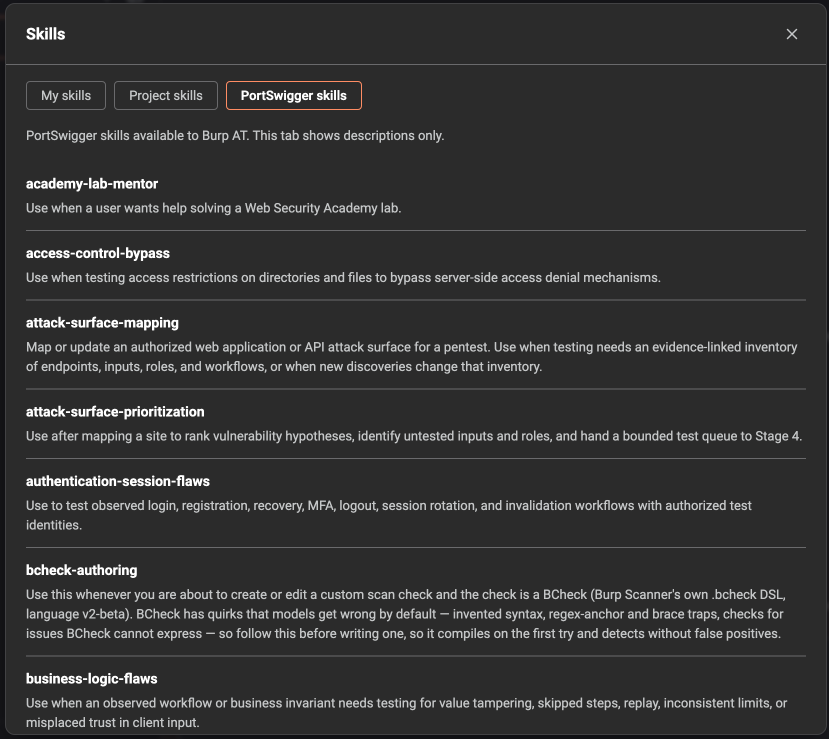
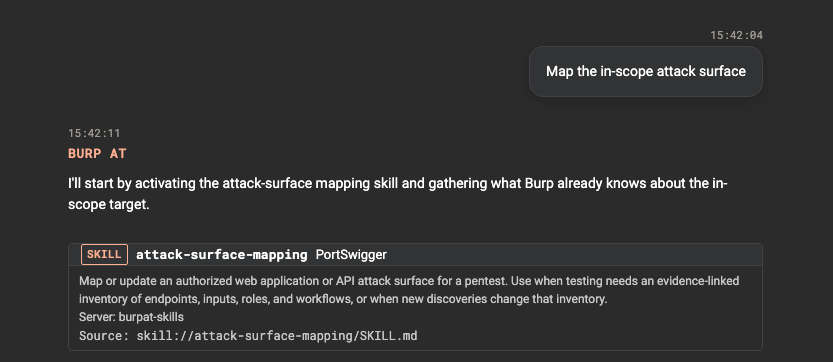
Burp AT comes with a library of specialist pentesting skills created in collaboration with PortSwigger Research. These give your agents methods developed by the researchers who present at Black Hat and DEF CON year after year. Burp AT selects relevant skills as it works, or you can invoke a specific skill using slash commands.
Crucially, they're paying particular attention to the tasks models most struggle with.
Expert methodology, with precision where it matters
Burp AT has skills for specific tasks throughout different phases of a pentest: mapping the attack surface during discovery, analyzing application behavior to identify promising avenues for investigation, testing for specific vulnerability classes, and turning findings into clear reports.
Across those tasks, instructions alone aren’t always enough. That’s why Burp AT skills are predominantly made of deterministic code, building on the approach James Kettle refined in his recent whitepaper, Can AI do novel security research? Meet the HTTP Terminator. Instructions guide the methodology, while code handles the steps that need precise, repeatable execution.
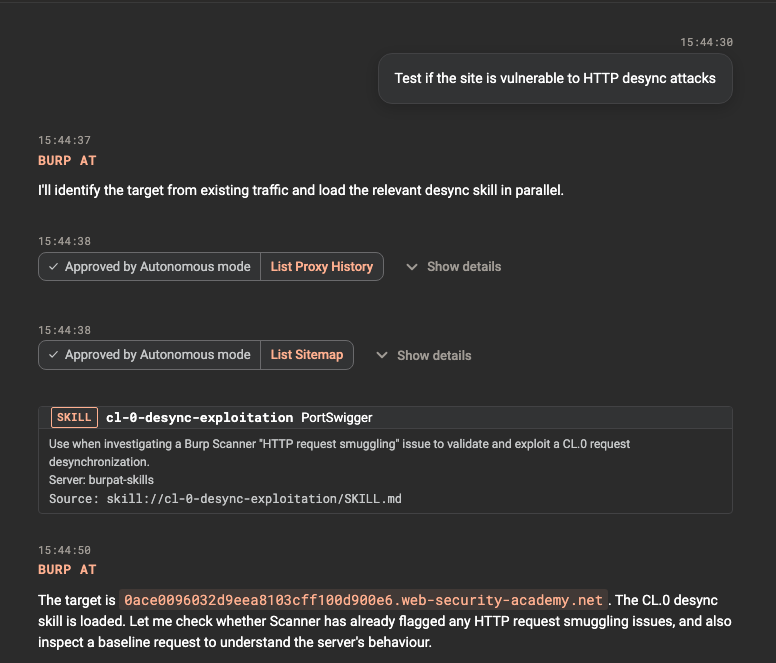
That leaves the agent to interpret results and decide what to investigate next, with specialist methods and code to support it at each phase.
A more consistent approach
Ask a general-purpose agent to test the same endpoint twice and you may get two very different approaches. One run examines every parameter. Another focuses on a single promising input and leaves the rest untested.
Skills give the agent a defined method to follow, reducing how much of the approach it has to invent on each run. Where a skill uses code, those steps execute consistently and predictably every time.
The agent still makes judgment calls about the application, the evidence, and what to try next. A skill gives those decisions a structure. It can also define how to handle incomplete results: distinguishing a validated vulnerability from a tentative issue, for example, and preserving evidence for you to investigate further.
That gives you a clearer basis for deciding what to delegate and which results need your attention.
From research breakthrough to your next test
Think about how you usually bring the latest research into your own tests. A technique debuts in a conference talk, a whitepaper or blog post follows, and then it's up to you to find it, interpret it, and work out how to apply it on a real engagement.
Burp AT automates that whole process. Skills are stored server-side, so as soon as PortSwigger Research publishes a new or updated skill, your agents can use it the next time they start a task. There's nothing to install and no prompts to rewrite.
Tom Stacey’s CRLF-Powered Desync skill is one example. Built from his research presented at Black Hat USA and DEF CON this year, it guides the agent through a sequence that would otherwise require specialist knowledge that even frontier models currently don't have.
As his write-up explains, the skill determines where an injected header appears in the upstream request, validates the desync by splitting requests, then searches for and attempts to exploit a suitable gadget. If a full desync isn’t possible, it can fall back to the separate CRLF-Powered Tunnelling skill.
"The skills being developed by PortSwigger Research are built to make the techniques we discover and use as practical as possible, as quickly as possible. By pouring our methodology into Burp AT, testers can identify critical vulnerabilities from novel attack vectors the second the techniques are published."
For client-side testing, Gareth Heyes’s CSP bypass skill brings his original research into the library.
You can still read the research and explore the technique yourself. But your agents can start applying it without waiting for you to catch up.
From incident to skill in hours
Skills also give us a new way to respond to major disclosures and CVEs.
When PHP2Shell was disclosed, we released new scan checks and, within a couple of hours, a Burp AT skill for finding vulnerable instances across your targets.
That gave Burp AT users a way to investigate the vulnerability while the disclosure was still new, without having to develop and test their own agent workflow first.
Tested before you get them, retired when you don't need them
A skill has to demonstrate a measurable improvement in the agent’s performance before we release it. If it doesn’t improve the benchmark results, it doesn’t ship.
We continue measuring performance after release. As models improve, we’ll retire skills that no longer provide a benefit, so agents don’t accumulate instructions for tasks they can already handle well.
If you maintain your own setup, that work falls to you: choosing what to build, benchmarking it, checking it after model updates, and removing what’s become unnecessary. With Burp AT, PortSwigger Research maintains the built-in library, leaving you to concentrate on hacking.
Plus your own methodology
PortSwigger Research's skills give your agents a strong foundation, but every pentester has their own approach. With Burp AT, you can add custom skills to supplement the built-in ones, tailoring Burp AT's behavior to your own methodology and preferences.
Try Burp AT skills in the public beta
Burp AT is available in public beta for Burp Suite Professional users.